
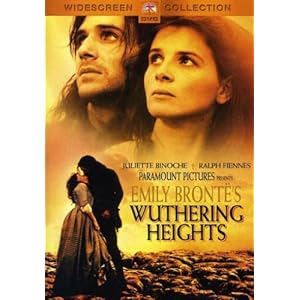
Starring Juliette Binoche and Ralph Fiennes
I debated what to review in my first post. Should I write about the movie I saw most recently or choose something that would make a better first impression? In the end I decided to choose the last movie I watched, Wuthering Heights. Not only is this the freshest film in my mind, but it also sets the tone for the rest of my blog. If you know anything about the storyling of Wuthering Heights, you can already guess how I feel about it. If not, here's a hint: I take my happy endings very seriously.
First, some back story: Sometime in high school I decided that I would read every classic ever written because, simply by being classics, they must have some inherent merit. Over time, I learned that the merit of so-called "classic" novels is more in their value as tools to teach society something about itself or about human nature than it is about about the joy they provide in reading them. I have several classics that I have found highly enjoyable, including Les Miserables, Pride and Prejudice, The Canterbury Tales, and The Scarlet Letter, among others. However, the list of classics that I have read that I have not enjoyed is much, much longer.
In fact, I refused to read Pride and Prejudice until my senior year of high school because I was convinced that it was a depressing, unpleasant read. I think I must have had it confused with Crime and Punishment, which while I've never read it, still appears to be a depressing, unpleasant read (that's why I've never read it). It was only after I saw a preview for the Bollywood movie Bride and Prejudice that I realized that Pride and Prejudice is exactly the type of book I would like to read. I immediately bought a copy and discovered one of my new favorite books of all time. So many happy endings! Perhaps I will go into that another time. For now suffice it to say that it remains one of the few classics that I believe truly enjoyable to read, beyond its amusing satire of society and human pride.
As I entered college, I started to realize that simply reading the classics just to read the classics might not be as fun as I had first thought. So many of the books were unhappy, with unhappy characters who met unhappy ends. If you moved past their value as an educational tool, many of these novels were downright unpleasant to read. I decided there was no use to reading books that weren't enjoyable to read. If they were interesting, sure. If they were boring and/or unhappy, there was no point in suffering through them just to say I had. This logic applies to Wuthering Heights.
It had always been on my list of "Classics I'll read someday" simply because I recognized the name, but it was among those that I knew nothing about. So when I saw it come across the desk at the library a few months ago, I leaped at the chance to scan the back and see if I wanted to read it. Imagine my shock when I discovered that it was one of the most depressing books in human history. I had always assumed it was along the lines of Pride and Prejudice, with an everlasting love that can't be beaten<--that was the part I'd heard of. After reading the back of the book, I rather decided that the "everlasting love" was beaten in every way possible and the book wasn't worth reading. Check that one off the list.
But of course I still feel bad about just writing off books that other people think are brilliant. So when it came through again, I felt obliged to check it out. Not in the check-it-out-from-the-library-to-read-it sense, but in the check-it-out-by-watching-the-movie-and-see-if-I-might-want-to-read-it-after-all sense. This brings me, finally to my review of the movie itself.
The actual review
If you are not familiar with the story of Wuthering Heights, let me explain the basic plotline. (I would put SPOILERS!! here except that the book has been around for 150 years, so it's sort of a moot point) Heathcliff is found and adopted by a moderately wealthy family who has a daughter named Cathy. Heathcliff, a shy and brooding young boy, falls in love with the bright and lively Cathy. Somehow, she falls in love with him as well. They form this deep, everlasting love that cannot be broken at all costs. Apparently. Trouble is, her father dies and her brother loathes Heathcliff, so he is relegated to being a servant in the household and is seen as being beneath Cathy and her family. One night, while Cathy and Heathcliff are spying through the windows of the enormously rich neighbors, the dogs chase them and they get caught trespassing. The rich family takes Cathy in and fawns over her wound while tossing Heathcliff out into the night without another glance. Cathy takes 3 months to "heal" under their care and comes back a changed woman. She is flighty and obsessed with nice things, and while Heathcliff has been tormented by her absence, she seems untouched. So much so that she agrees to marry the rich young man who cared for her, simply because she would be the richest lady in the neighborhood. Heathcliff is so distraught at this news that he disappears into the night and does not return for 2 years.
Enter the main character in the story: revenge. Heathcliff comes back with loads of mysteriously gained wealth and begins to enact his plot of revenge on everyone he's ever known. Cathy's brother, who used to kick Heathcliff around, ends up selling his estate to Heathcliff because the death of his wife in childbirth drove him mad and he drained away his wealth. So Heathcliff has his revenge on the brother. It just so happens that Wuthering Heights (the name of the estate and also the book) is the neighboring mansion to where Cathy lives, so it's easy for him to torment her and her rich husband as well. He creates so much tension between himself and her husband that she gets extremely ill after the birth of her daughter and dies ("of a broken heart," apparently).
Heathcliff takes the rich husband's sister and forces her to marry him. He is enormously abusive but she bears him a child as well. So let's recap: Cathy marries the rich husband, Heathcliff leaves only to return a rich, angry man. 3 children are born and Cathy dies of a broken heart, leaving the rich husband with a daughter, Heathcliff with a son, and also the son of Cathy's brother (he died soon after Cathy). This paints a great picture, right? You can just feel the joy and happiness already...
So fast forward 20 years and the 3 kids are all grown up. Catherine is a lovely younger version of her mother. Heathcliff took revenge on the brother's kid by making him into his servant the way his father had done to Heathcliff all those years ago. Heathcliff's own son grows up pampered and only returns after his mother dies (perhaps this is better explained in the book?). Catherine accidentally meets Heathcliff and his son after 20 years of her father forbidding her to talk to them. They charm her, and she is tricked into returning to their house later when the son writes her a letter promising love. Heathcliff locks her in the house, beats her around a little bit, and bullies her into marrying his dying son. Just so happens her father is also dying. (don't you love how these gothic novels are so well planned?) She does it so she can see her father, and badda bing, badda boom, Cathy is widowed and her inheritance went from being hers upon the death of her father to being willed to Heathcliff by her husband shortly thereafter. So she's stuck living at Wuthering Heights with Heathcliff and he's all grumpy and abusive.
Thankfully, her cousin (Cathy's brother's son, if you'll remember) is also there as a servant, and they form this sort of bond. She teaches him to read and he gives her some pleasant company. Eventually the tenant who's renting out Catherine's old home--the rich family's house, now owned by Heathcliff--comes by, awakens the ghost of Cathy that Heathcliff summoned all those years ago, and voila, that's it. Heathcliff goes back into her room for the first time in 20 years (apparently), he frolicks with her ghost in his dream, and then he dies. Catherine and her cousin are left to be happy together, and Bronte aptly concludes that a whole generation was lost forever. The grandparents were happy, the parents led atrociously unhappy lives, and finally the kids are back to being happy(ish) again.
So, whew! Lord knows I don't know how to write short summaries... I will reiterate that I have never read the novel, so there may be slight deviations here and there, but this is the plotline as laid out in the movie. Now to review this particular version.
In the very first scene of the movie, I knew we were going into a perfect gothic story. A sweeping plain, over which hang dark, ominous clouds. So gothic. Then a young woman starts walking across the plain and walks up to a decrepit mansion. I'm thinking, okay, so who is this and why is the mansion crumbling? Is this like Jane Eyre (incidentally written by Emily Bronte's sister, Charlotte Bronte), where somebody sets fire to the mansion and destroys it figuratively as well as literally? This woman is apparently Emily Bronte herself, who has stumbled upon the ruins of a once-great mansion and is making up a story to explain how it got to that state.
I think. I suspect that this is a device created to capture the voice of Bronte as it appeared in the novel. It reminds me of other gothic novels, where the author cautions about the story that is forthcoming. It felt a little unnecessary in the movie as it distracts from the actual plotline. I really liked her last line, as I mentioned, so I suppose it was a useful ploy to include her in the movie, but I think they could have done without it.
The second story-within-the-story is the appearance of a strange man at the estate, who is verbally abused by an older Heathcliff and then sees the ghost of Cathy. I suspect this too is pulled from the novel. However, when you start with Bronte wandering around in a decrepit house and then show another random man wandering around in the same house before it was ruined, you start to wonder who you're supposed to be focusing on. Why are these people important?? I felt that this gentleman's story was similar to Bronte's, where it served to create a nice circle around the story, but it was more of a distraction to me than anything else (for example, when I heard that he was a tenant at "La Grange," I naturally assumed he was a tenant farmer on Heathcliff's land and that "La Grange" was referring to a plot of land and sad little house on the Wuthering Heights estate. Come to find out about 3/4 of the way through that La Grange is actually the rich family's house. Those kinds of little details can be easy to miss in a film where unfamiliar names are unconsciously ignored, so I spent most of the movie being really confused about who lived where and why they were talking about La Grange when they had been referring to the rich family's mansion only moments earlier.) As I said, a distraction.
Then we get to the actual story. Finally! Juliette Binoche was radiant as Cathy. She was bubbly and adorable and seemed to fit the part well. I know Ralph Fiennes first from his role as Voldemort in the Harry Potter movies and also from his starring role in The Duchess and Keira Knightley's abusive husband. Incidentally, I found a lot of similarities between this movie and The Duchess. Coincidence? Who knows. This was another one of his spine-tinglingly creepy roles. As Voldemort, he was just plain evil. As the Duke of Devonshire in The Duchess, he was aloof and alarmingly chauvinist. As Heathcliff, he was like a mental patient. He was disturbingly brooding, and at times the thinly veiled anger that constantly bubbled under the surface would break through in a violent outburst. This became more frequent as Cathy came back from her time at La Grange, clearly infatuated with Edgar and all his fine things. When Heathcliff came back from his unexplained absence, he was extra creepy. No longer simply brooding, but appearing to revel in his madness. His eyes would light up with revenge when he was taunting Cathy's wealthy husband, and he showed no mercy or regret as he used several different people as human punching bags.
The more I see of Ralph Fiennes, the more I wonder if I would like him as a person. I mean, the jobs an actor takes really say nothing about their true character. Some people are just born to play villains. Ralph Fiennes plays them very well. But now I've seen him as a gleeful torturer and murder in Harry Potter, a ruthless rapist and oppressor in The Duchess, and now a madman bent on revenge in Wuthering Heights. Just starts to make you wonder, after a while...
The thing that bothers me most about this story is how it's all done in the name of love. Cathy and Heathcliff claim their love can top anything, but all it takes is for someone to dangle a few pretty dresses in front of Cathy for her to run off with the rich boy. Heathcliff sticks by his claim of eternal love by coming back to torture everyone and their brother for stealing Cathy away from him. Cathy even claims that she's dying because Heathcliff broke her heart. On her deathbed, they're arguing about who's to blame for why she's dying. Heathcliff blames her because--and I quite agree--she left him for someone else. But she's all defensive that he won't leave Edgar alone so it's all his fault she's dying. Selfish to the end, I say.
Even so, I don't think Heathcliff's anger over losing his true love gives him the right to torment 2 generations of people. That's quite selfish of him. It's like dude, she's dead, get over it. Stop torturing your kids!
If there's one thing I can't stand, it's evil deeds done in the name of love. Heathcliff torments 2 whole families just because his true love chose money over love. A few months ago, I grabbed up another "classic" that was described as being about true love, only to discover the Doctor Zhivago is actually a story about infidelity. I was so crushed by this betrayal (how dare they say it was the greatest love story of all time!) that I didn't even finish it. I still don't know how it ends. This was another example of love being the excuse given for rotten behavior. "True love" doesn't give you any right to leave your wife. Same as it doesn't give you any right to torment everyone in your path just because your "true love" didn't want you. WHATEVER, Heathcliff. Just whatever.
I think it's quite clear at this point how I felt about this film. It was almost completely devoid of happy endings, even temporary ones. From the very start, people were getting hurt and treated poorly. It's not until 5 people have died that things finally calm down and happiness is possible again. NOT COOL. Perhaps someday I will read this book to revel in its pure gothic sentiments, but until then, it gets stuck on my list of unhappy endings. Out of a possible rating of 5 rainbows and ponies, it gets one donkey for being well made. It would have been much higher if they just could have squeezed a genuinely happy ending out of it. But then, it wouldn't be the gothic novel that made it what it is.
Rating (out of 5 rainbows and ponies): One donkey
Conclusion: UNHAPPY ENDING


How about Ralph Fiennes in Constant Gardener - there is a complex role where he aint all bad, though you do get to wonder abut him for a while....not sure that the movie would pass your happy endings test. It is one of my all time favs. though and not just for the setting.
ReplyDeleteThat's one I haven't seen. He has so many movies that I've heard of and never seen, but I'd never heard of him before Goblet of Fire came out in 2005. Perhaps I shall have to check out the Constant Gardener to see him in a less violent role.
ReplyDelete